कोष्ठक में दिए गए शब्दों से संज्ञा का उचित रूप बनाकर रिक्त स्थानों की पूर्ती कीजिए ।

A Fishy story
2. Answer the following questions in 30-40 words.
a) The neighbourhood of Streatley and Goring is a great fishing centre. The river abounds in pike, roach, dace, gudgeon, and eels and one can sit and fish for them all day. Some people do but they never catch them.
b) The author was an extremely neat thrower, had plenty of gumption and quite enough constitutional laziness. However, to become a great angler, he would require more imagination, more power of invention and the ability to tell lies easily.
c) The young man began counting each fish that he caught as ten, and to assume ten to begin with. Then, if he really caught one fish, he called it twenty, while two fish would count thirty and so on.
d) The old fellow told the author that he had caught the trout just below the bridge with a minnow and it weighed eighteen pounds six ounces. He further added that one didn’t see many fish that size about there then.
3. Answer the following questions in 100-120 words.
a) One day when the author and his friend George were in a parlour, they began chatting with an old fellow there. Then, the old fellow said that the trout weighed eighteen pounds six ounces and he had caught him just below the bridge with a minnow. The local carrier, who had just stopped at the inn, said that it was nearly five years ago that he had caught that trout below the lock and it weighed twenty-six pounds. Five minutes later, a third man came in and described how he had caught it early one morning, bleakly. After he left, a middle-aged individual came in. He told the author and his friend how it had taken him half an hour to land it, broke his rod and weighed thirty-four pounds. Finally, the landlord came and told the real history how he had caught it when he was quite a lad.
b) The author and his friend George has heard all the false stories and shared them with the landowner. The landowner in turn told them the real history behind the trout. After the landowner left the room, they again turned their gaze upon the fish. The more they looked at it, the more they marvelled at it. It excited George so much that he climbed up on the back of a chair to get a better view of it. And then the chair slipped, and George clutched wildly at the trout-case to save himself, and down it came with a crash, George and the chair on top of it. That trout lay shattered into a thousand fragments. They thought it strange and unaccountable, if it had been a stuffed trout, but it was not. That trout was plaster-of Paris. Thus, the truth behind the huge trout was finally discovered.
Leçon 5 –
Qu’est-ce que je ferai ?
Grammaire –
Le futur simple
Le futur
simple is used for talking about the events which will take place after a long
time i.e. maybe after a few months or years and therefore there can be a kind
of uncertainty of happening it.
Construction
of the sentence –
Subject +
radical of the verb + endings ai/as/a/ons/ez/ont
Radicals of
the verbs – 1) For ER verbsand IR verbs radical and the infinitive are the
same.
e.g. radical
of ‘chanter’ is chanter itself. So take the whole verb and add the endings as
per the subject.
Note these
radicals – acheter – achèter
Peser
– pèser
Jeter-jetter
Appeler –appeller
Employer – emploir
e.g. regarder – to see
Je
regarderai – I will see
Tu
regarderas – you will see
Il/Elle/On
regardera – He/She/Everybody will see
Nous
regarderons – we will see
Vous
regarderez – you will see
Ils/elles
regarderont – they will see
Radical of
‘remplir’ is remplir itself.
e.g. choisir – to choose
Je choisirai
– I will choose
Tu choisiras
– you will choose
Il/Elle/On
choisira – he/she/everbody will choose
Nous
choisirons – we will choose
Vous
choisirez – you will choose
Ils/elles
choisiront – they will choose
2) For RE verbs remove R from the infinitive and
the remaining verb is infinitive. E.g. radical of ‘vendre’ is ‘vendr’.
e.g. vendre – to sell
Je vendrai –
I will sell
Tu vendras –
you will sell
Il/Elle/On
vendra – He/she/Everybody will sell
Nous
vendrons – we will sell
Vous vendrez
– you will sell
Ils/Elles
vendront – they will sell
3) here are
some irregular radicals.
|
verb |
radical |
|
Venir –to come |
viendr |
|
Aller – to go |
Ir |
|
Avoir- to have |
Aur |
|
Être-
to be |
Ser |
|
Vouloir – to want |
Voudr |
|
Savoir – to know |
Saur |
|
Faire – to do |
Fer |
|
Voir – to see |
Verr |
|
Obtenir – to obtain |
Obtiendr |
|
Pouvoir – to be able to |
Pourr |
|
Recevoir – to receive |
Recvr |
|
Tenir – to hold |
Tiendr |
|
Mourir – to die |
Mourr |
|
Devoir - must |
Devr |
|
Falloir – must,necessary Pleuvoir – to rain |
Faudr – Il faudra – it will be
necessary Pleuvr – Il pleuvra These two verbs have only one
conjugation. |
# when the
question is in the form of fill in the blanks the key words in the sentence are
‘dans une année, après deux ans ‘ etc.
Coin culturel –
L’université de
Sorbonne
Crée par
Robert de sorbon
En 1253
Se trouve à Paris
Connue comme –
l’Université de Paris
CELL STRUCTURE AND ITS FUNCTION:
MICROORGANISM- FRIEND AND FOE:
MATERIALS- METALS AND NON METALS:
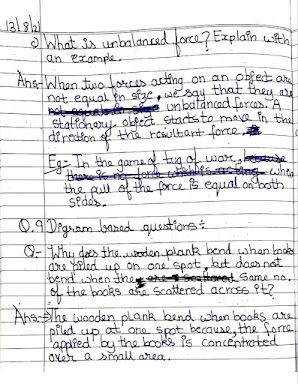
FORCE AND PRESSURE: